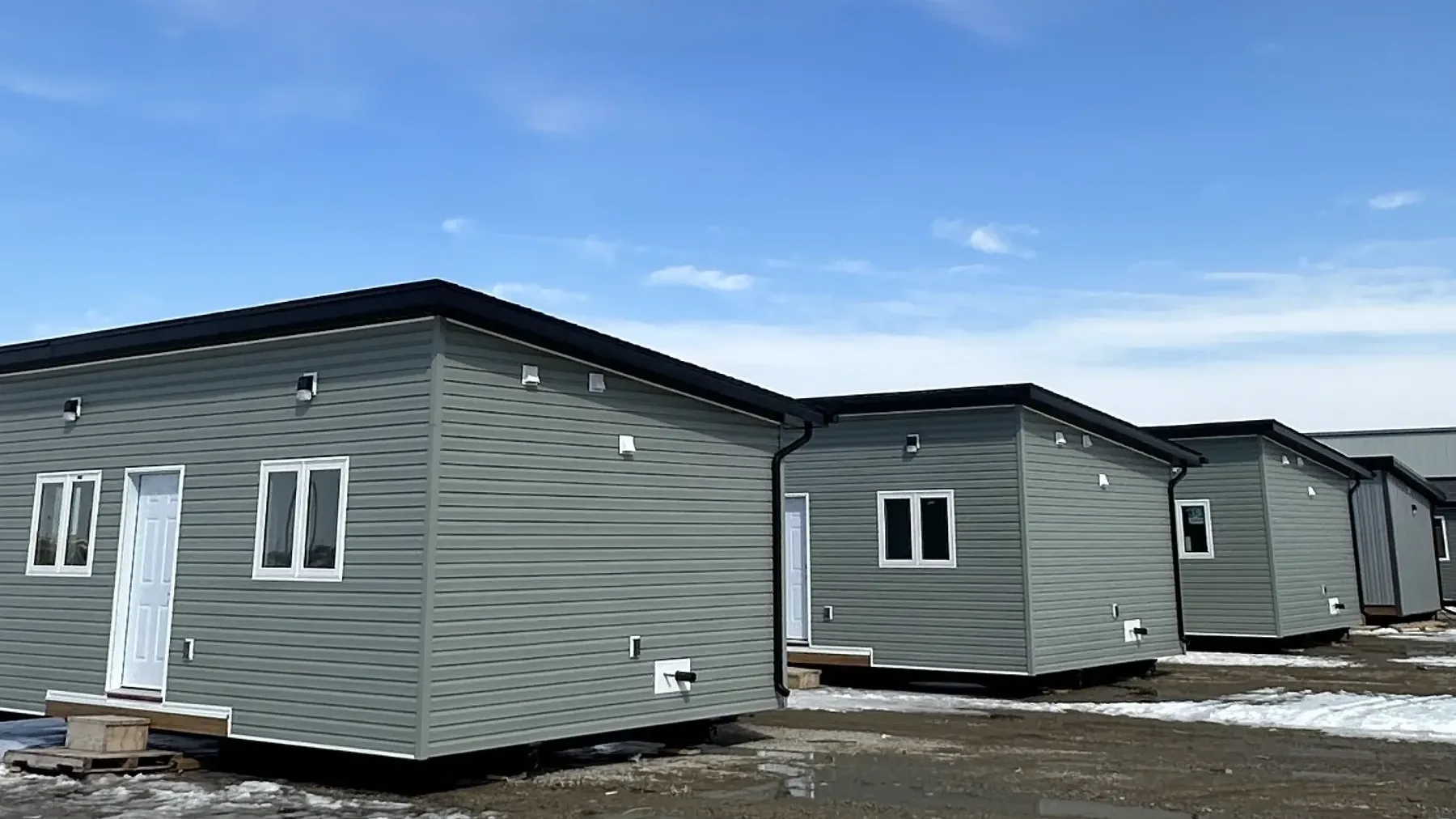
Canada needs to roughly double the number of homes it starts each year, and federal housing money has shifted from paying for faster approvals to paying for buildings, with an explicit preference for factory-built construction. For a municipality, a First Nation or a developer planning multi-unit housing on the Prairies or in the North, the practical question is no longer whether factory-built housing is eligible. It is whether the project is set up early enough to use a factory's capacity.
This article sets out what CMHC estimates, what each federal program actually funds as of October 2026, what the Rapid Housing Initiative taught about delivering modular housing on a deadline, and what that means for projects in Saskatchewan, Manitoba, Alberta and the territories. Herauf does not administer any of these programs; where Herauf is mentioned, it is with facts already published on this site.
How big is Canada's housing supply gap?
CMHC's Fall 2026 Housing Supply Report, published September 10, 2026, estimates that Canada needs between 417,000 and 469,000 housing starts a year to bring affordability back to pre-pandemic levels by 2036. On current trends, CMHC projects about 231,000 a year. The shortfall, 187,000 to 238,000 homes a year, is broadly unchanged from its 2025 estimate.
The 2025 report that introduced this framework is careful about what the number means. Returning to 2019 affordability is an aspiration used to show the scale of the problem, not an official target. It also says the goal can only be reached with a much larger workforce, more private investment, and changes in technology and productivity, naming more automation and modular construction specifically. CMHC modelled what better construction productivity alone would do: a 10% gain adds about 17,000 starts a year nationally, and matching the all-industry average (a 31% gain) adds about 51,000 and lowers 2035 house prices by 5.7%. It also observes that many builders are too small to make the technology investments that raise productivity.
What the numbers say for the Prairies
The Prairie picture is uneven. In the 2026 report Edmonton is the only large market in Canada with no measurable supply gap, while Calgary still needs 4,000 to 5,000 more starts a year than it is on track for. The 2025 framework, which broke results out by province, put the required increase at about 48% in Manitoba (from roughly 7,550 starts a year to 11,190), about 39% in Saskatchewan (4,850 to 6,720), and about 83% in Alberta outside Calgary and Edmonton (6,340 to 11,570). The smaller centres carry a larger share of the increase than their size suggests, and they are the places with the fewest local trades to absorb it.
What does the Housing Accelerator Fund actually pay for?
The Housing Accelerator Fund (HAF) pays local governments to change their approval systems, not to build. Communities sign agreements that commit them to zoning changes, faster permitting and building permit targets, and receive federal funding in return. Since its launch in March 2023 it has committed $4.37 billion through 241 agreements chosen from more than 540 applications. In the first year, participating governments issued 160,585 residential building permits, about 22,000 more than expected.
As of October 2026, HAF applications are closed and the program is in its enforcement phase. In January 2026 CMHC cancelled Red Deer's agreement for missing a mandatory requirement and reduced Toronto's and Vaughan's funding, with the recovered money offered to communities launching new initiatives. For anyone building in a HAF community, that matters: council has a federal reason to keep permits moving, and a multi-unit project that is easy to approve helps it meet its target. Faster approvals are also what let a factory-built project keep its schedule, because the manufacturing can only start in earnest once the design is approved.
What does Build Canada Homes fund?
Build Canada Homes is the federal government's housing delivery agency, launched on September 14, 2025 as a Special Operating Agency within Housing, Infrastructure and Communities Canada with an initial $13 billion. It finances projects, provides public land and partners with provinces, territories, municipalities, Indigenous communities and non-profits. From the start it said it would prioritize factory-built, modular and mass timber construction, and it adopted the federal Buy Canadian policy, favouring Canadian lumber, steel and other materials.
Its own building program, called Direct Build, began with six sites on federal land, about 4,000 homes, that prioritize modular and factory-built methods. Two are on the Prairies: 320 homes on a parcel at Naawi-Oodena in Winnipeg, with Treaty One First Nations and Canada Lands Company, and 355 homes at the Village at Griesbach in Edmonton. In February 2026 the agency issued a Request for Information to volumetric modular builders, panelized system manufacturers and design-build firms, closing March 5, 2026, to shape a future prequalification process for factory-built suppliers.
Through 2026 it has also signed partnerships with provinces and territories, several of which name factory-built delivery directly:
- Alberta (September 9, 2026). Up to $220 million from Build Canada Homes toward at least 1,460 affordable units, with partners incorporating modern methods of construction, including off-site and factory-built approaches.
- Manitoba and Winnipeg (September 8, 2026). Up to $104.7 million from Build Canada Homes toward at least 820 units, with a target of at least 100 homes built using modern methods of construction.
- Northwest Territories (July 27, 2026). An agreement in principle with Housing Northwest Territories for at least 560 affordable units through a combined investment of about $480 million, most of them social housing.
- Urban, rural and northern Indigenous housing (April 24, 2026). Close to $1.7 billion of the $4 billion federal strategy flows through Build Canada Homes to Indigenous housing providers, with intake details still to be announced as of October 2026.
Each of these is a framework: the agency says individual projects remain subject to due diligence, approvals and project agreements. The direction is clear, though. Federal capital for affordable housing now arrives with an expectation that some of it will be built in a factory.
What did the Rapid Housing Initiative teach?
The Rapid Housing Initiative (RHI) is the clearest Canadian test of what happens when money comes with a deadline. Launched in October 2020, its first round required modular construction (with exceptions for the North and remote sites) and asked projects to be ready for occupancy within 12 months, or 18 in the North. It ran three rounds and is now closed. CMHC's 2025 evaluation of the first two rounds found 552 projects and 10,298 units funded by November 2023, well above the 7,500-unit target, with more than half the projects built modular. About half the projects were led by Indigenous governing bodies, nearly all of them First Nations, and First Nations households were the largest group served, at 42% of units.
The deadline was hard to meet. Only 22% of first-round projects and 33% of second-round projects met their completion target. In the second round, 39% of modular projects finished on time against 25% of site-built ones, and the on-time modular projects tended to be the larger ones. In the first round the pattern reversed, which the evaluation linked to a shortage of modular supply when every project was required to use it. Communities in Nunavut and Inuit Nunangat, where materials arrive on a once-a-year sealift, often could not score well on speed at all.
Three lessons carry forward. Factory-built housing is faster when the factory has capacity reserved for the project, not when a whole program competes for the same production lines at once. Projects that were shovel-ready, with land, servicing and approvals in hand, were the ones that could use the speed. And in the North, the delivery season sets the schedule as much as the build does.
Where does the Housing Design Catalogue fit?
In March 2025 the federal government released the first of more than 50 free, standardized designs for rowhouses, fourplexes, sixplexes and accessory dwelling units, with regional sets that include one for Saskatchewan and Manitoba and one for the territories. Before releasing them it invited companies building modular, panelized and 3D-printed houses to submit their designs. A repeatable, pre-approved design is exactly what a factory builds most efficiently, and it is what lets a municipality approve the second and third project faster than the first.
What this means for municipalities, First Nations and developers
Municipalities
Most of the federal money now reaches buildings through partnerships and agencies, not municipal grants, so a municipality's strongest lever is readiness: serviced land, zoning that allows the building type, and an approval path that treats a factory-built multiplex the same as a site-built one. Agree early with your building official how factory-closed walls will be accepted, what will be inspected on site (the foundation, connections and services), and what documentation the manufacturer must hand over. Herauf's guide to quality control in a modular factory covers who inspects what.
First Nations and Indigenous housing providers
The RHI showed that Indigenous-led projects can use factory-built housing well, and the $1.7 billion now routed through Build Canada Homes is the next large source of capital for urban, rural and northern Indigenous housing. On-reserve programs from Indigenous Services Canada and CMHC remain separate; they are explained in funding modular buildings for First Nations. Whatever the source, plan the build around the delivery window: a winter road or barge season is fixed, so manufacturing has to finish before it opens.
Developers
Build Canada Homes is building a list of factory-built suppliers and setting targets for modern methods of construction in its provincial partnerships. A developer who wants that capital should bring a manufacturer in at concept design, when module sizes, the structural grid and the transport envelope are still cheap to change, and should plan for repetition: the same unit types, stacked and repeated, are where a factory's schedule advantage is largest. The trade-offs for small multi-unit buildings are covered in multi-family and infill housing.
The North
The Northwest Territories agreement alone calls for at least 560 units. In the North a building finished complete in a southern plant, then moved by highway, winter road or barge, turns a short construction season into a delivery date. Herauf's approach is described on northern and remote modular buildings.
Where Herauf fits
Herauf builds indoors at a 35,000 sq ft production hub in Zehner, Saskatchewan and a 50,000 sq ft facility in Enderby, British Columbia, with a full-service yard at St. Paul, Alberta, and has delivered projects across British Columbia, Alberta, Saskatchewan, Manitoba and the Northwest Territories. Its buildings meet or exceed CSA A277 and the National Building Code for climate zones 6 to 8. Community housing it has delivered includes 20 homes for Buffalo Lake Métis Settlement, built with CMHC and government partners, and homes for St. Theresa Point First Nation carried roughly 700 km over winter ice roads. Multi-family and infill housing is one of its product lines, alongside the commercial and institutional buildings described on Indigenous community buildings.
Public buyers and housing providers can find supplier details, references and a capability statement on the procurement page. To discuss a multi-unit project, send the site, the unit count and the funding program you are working with through the multi-family quote form, or call 1.639.382.4106.
Sources
- Canada Mortgage and Housing Corporation, Fall 2026 Housing Supply Report
- Canada Mortgage and Housing Corporation, Slowing home construction threatens recent affordability gains (September 10, 2026)
- Canada Mortgage and Housing Corporation, Canada's housing supply shortages: moving to a new framework
- Canada Mortgage and Housing Corporation, Update on the Housing Accelerator Fund agreements for Red Deer, Toronto, Vaughan (January 16, 2026)
- Canada Mortgage and Housing Corporation, Housing Accelerator Fund
- Prime Minister of Canada, Prime Minister Carney launches Build Canada Homes (September 14, 2025)
- Housing, Infrastructure and Communities Canada, Build Canada Homes: thousands of homes in the pipeline (January 7, 2026)
- Housing, Infrastructure and Communities Canada, Build Canada Homes launches Request for Information on Modern Methods of Construction (February 4, 2026)
- Housing, Infrastructure and Communities Canada, Build Canada Homes accelerates affordable housing in Winnipeg (November 12, 2025)
- Housing, Infrastructure and Communities Canada, Build Canada Homes accelerates affordable housing in Edmonton (November 12, 2025)
- Build Canada Homes, Build Canada Homes and Alberta partner to deliver more affordable homes across the province (September 9, 2026)
- Build Canada Homes, Build Canada Homes partners with Manitoba and Winnipeg to accelerate affordable housing delivery (September 8, 2026)
- Housing, Infrastructure and Communities Canada, Canada and Northwest Territories partner to build more homes and essential infrastructure (July 27, 2026)
- Housing, Infrastructure and Communities Canada, Delivering on funding for urban, rural and northern Indigenous housing (April 24, 2026)
- Canada Mortgage and Housing Corporation, Evaluation of the Rapid Housing Initiative (August 2025)
- Housing, Infrastructure and Communities Canada, Federal government unveils designs as part of the Housing Design Catalogue (March 7, 2025)
- Canada Mortgage and Housing Corporation, About the Housing Design Catalogue
Common questions
How many homes does Canada need to build each year?
CMHC's Fall 2026 Housing Supply Report estimates Canada needs 417,000 to 469,000 housing starts a year to restore pre-pandemic affordability by 2036, against a business-as-usual projection of about 231,000. CMHC presents this as an illustration of the size of the gap, not an official government target.
What does the Housing Accelerator Fund pay for?
The Housing Accelerator Fund pays local governments to change how they approve housing: zoning reform, faster permitting and building permit targets. It does not buy buildings. Since March 2023 it has committed $4.37 billion through 241 agreements, applications are closed as of October 2026, and CMHC has cut or cancelled agreements where commitments were not met.
Does Build Canada Homes fund modular housing?
Yes. Build Canada Homes, the federal housing agency launched in September 2025 with an initial $13 billion, prioritizes factory-built, modular and mass timber construction. Its six Direct Build sites, including Naawi-Oodena in Winnipeg and Village at Griesbach in Edmonton, prioritize modular and factory-built methods, and its 2026 partnerships with Alberta and with Manitoba and Winnipeg include modern methods of construction.
What happened to the Rapid Housing Initiative?
The Rapid Housing Initiative ran three rounds from 2020 and is closed. CMHC's 2025 evaluation found its first two rounds funded 10,298 units in 552 projects by November 2023, that more than half the projects were modular, and that modular projects in the second round met their completion target more often than site-built ones, while a shortage of modular supply slowed the first round.

Finished homes backed up to trucks in a snowy yard at dusk, ready for delivery