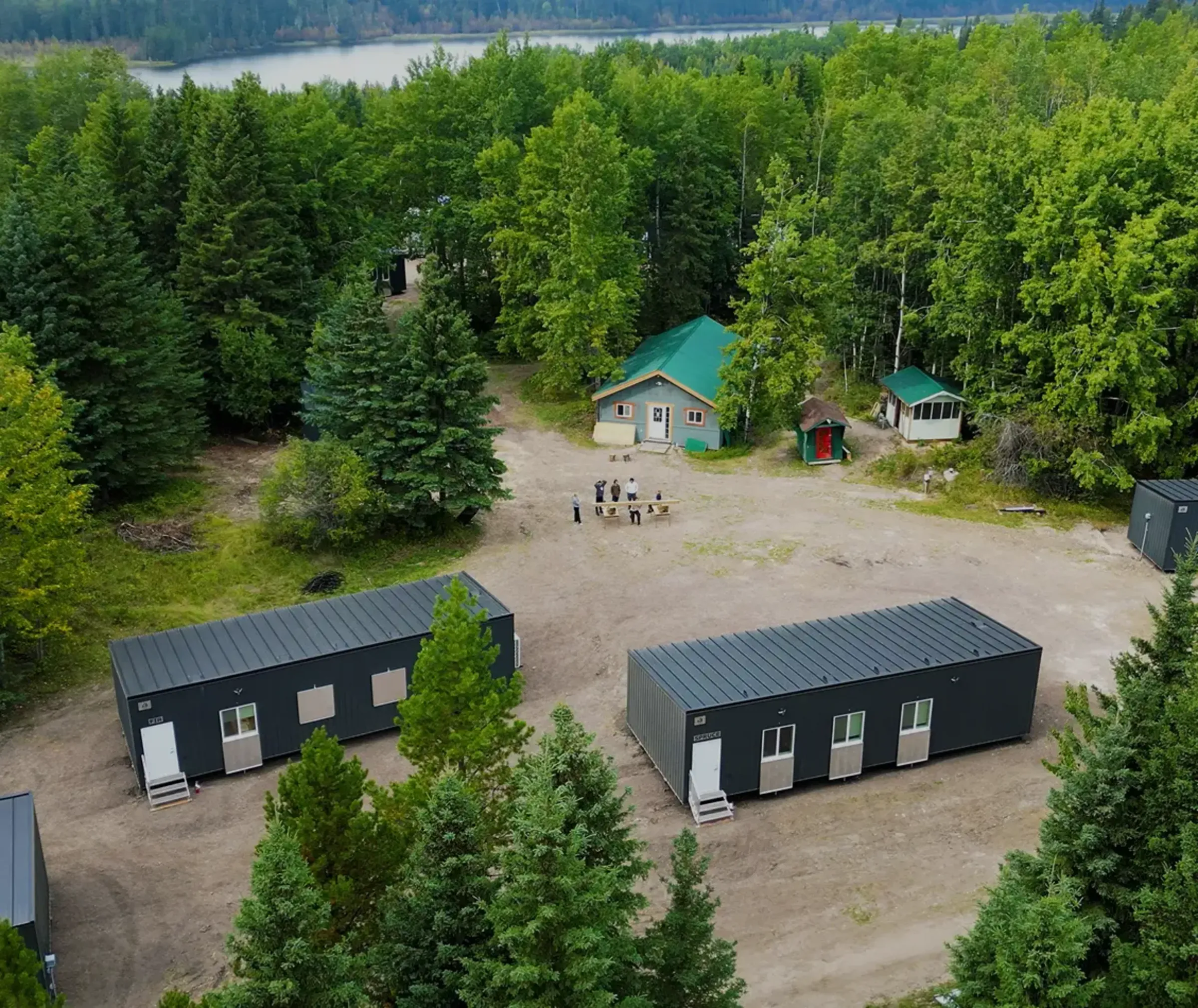
A delivered-project page is useful when it helps a buyer compare conditions, responsibilities and evidence, not when it is treated as a ready-made quote. Herauf's documented work at NAIT Kidney Lake, Pilot Butte and Buffalo Lake represents different uses and sites, so each answers a different planning question.
The facts below come from Herauf's existing project records. They do not add performance claims, client quotations or outcomes beyond those published records.
NAIT Kidney Lake: plan the whole programme
The NAIT Kidney Lake field-school project documents dormitory buildings, classrooms and food storage at a remote campus. The transferable lesson is to describe the complete operating programme. Sleeping, teaching, food storage, services and access are connected requirements, not separate product searches.
For a new campus, workforce or institutional brief, list every building type, user group and shared dependency. Then identify which parts must open together and which can be phased.
Pilot Butte: connect the layout to public use
The Pilot Butte project documents an accessible washroom and change facility for a spray park. It shows why fixture programme, accessible use, service connections, placement and the public setting belong in the same brief.
A park, campground or community-facility buyer should record who uses the building, peak demand, accessibility requirements, available water and wastewater, seasonal operation and maintenance access before choosing a layout.
Buffalo Lake: distinguish programme size from a promise
The Buffalo Lake Métis Housing project documents a 20-home programme. It is relevant evidence for community housing, but it does not turn 20 homes into a standard price, model mix or delivery schedule.
For a proposed 10-, 25- or 50-home development, use the documented project to ask what differs: household requirements, models, accessibility, land, services, route, phases and project responsibilities. Then build the new plan from those facts.
References add a separate evidence layer
The signed reference letters are first-party client documents connected to named work. Read the original letter and project page together. Do not generalize one client's statement into a universal outcome.
A six-part case-study comparison
- Use: housing, education, washroom, office or another operational need.
- Programme: buildings, rooms, capacities and interfaces.
- Site: access, support, services, staging and seasonal conditions.
- Scope: what each party supplied, coordinated or still had to resolve.
- Evidence: project photographs, published facts and signed references.
- Limits: what the record does not prove about a future project.
Use the scope and proposal tools to turn those lessons into a new responsibility matrix. For a housing programme, add the community housing phasing guide.
Choose evidence relevant to the brief
Browse all completed projects by sector and open the individual record that most closely matches the new use and constraints. A close match improves the questions; it does not replace project-specific review.
Common questions
Can a completed modular project be used as a price or schedule benchmark?
Not by itself. A completed project proves that particular work was delivered. A new price or schedule still depends on the new building programme, site, route, services, responsibilities, approvals and current written proposal.
What should buyers compare between case studies?
Compare intended use, building type, quantity, site and route conditions, foundation or support, services, owner responsibilities and available client evidence. The most relevant project is the one with similar constraints, not simply the same number of modules.
Where can I verify Herauf project evidence?
Use the individual project pages, photographs and signed client reference letters on Herauf's results and references pages. Treat each statement as evidence for that named project only.